
Gender Sensitivity in Sexual Offence Cases: Comparing the Supreme Court’s New 2026 Guidelines with the 2023 Handbook
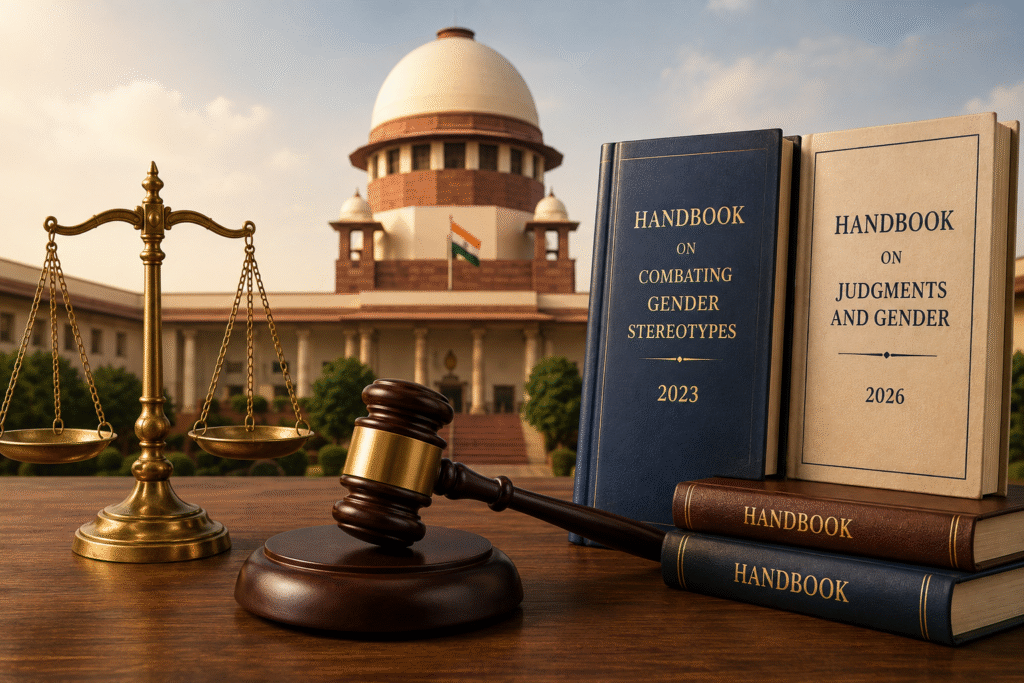
Following directions from the Supreme Court, an Expert Committee set up by the National Judicial Academy (NJA) has released a fresh set of guidelines aimed at helping judges adopt a more gender-sensitive, survivor-focused, and compassionate approach in court.
The panel, chaired by former Supreme Court judge Justice Aniruddha Bose, was formed after Chief Justice of India Surya Kant observed that the Court’s 2023 Handbook on Combating Gender Stereotypes — introduced under former CJI D.Y. Chandrachud — leaned too heavily on academic language and Western frameworks to be easily understood by the average reader. Earlier this year, CJI Kant directed the NJA to revise the approach and produce clearer, India-specific guidance for judges handling sensitive cases.
The CJI’s central worry was that existing norms didn’t reflect India’s own social context and were too complex for practical use. This concern followed a case in which an Allahabad High Court bench was seen as tone-deaf in its handling of a sexual offence matter — prompting the CJI to note that earlier attempts at judicial sensitization hadn’t produced the intended results.
In response, the NJA’s Expert Committee has now released its report, titled “Judgments and Gender” (the 2026 report), developed after examining 125 trial court judgments and consulting members of State Judicial Academies.
What the 2026 report covers
The report stresses how language choices shape justice outcomes. It includes a detailed list of problematic terms commonly used in judgments, along with more legally sound alternatives. It urges judges to steer clear of victim-blaming, rely strictly on evidence, and avoid drawing negative conclusions from how a victim behaved after the incident. It also pushes for framing that centers bodily autonomy and dignity rather than outdated notions of “chastity” or “honor.”
Specifically, the report advises against speculating on a victim’s clothing, lifestyle, or sexual history, and recommends that judgments use precise legal terminology instead of dramatic or moralistic language.
How it differs from the 2023 Handbook
Scope: The 2023 Handbook takes a wide-ranging look at how stereotypes — related to gender, caste, class, disability, and more — can creep into judicial reasoning across all types of cases. It illustrates, for example, how assumptions about economic background might unfairly influence bail decisions. The 2026 report, in contrast, zeroes in specifically on sexual offence cases and focuses more on the practical language used in decision-writing. It lays out nine broader principles for writing judgments and warns that insensitive wording can discourage survivors from coming forward or add to their trauma.
Glossary of terms: Both documents flag problematic words and suggest replacements, though their emphasis differs. The 2023 Handbook focuses on how victims or survivors are described — recommending, for instance, that loaded terms tied to a woman’s character be dropped in favor of neutral language, and that terms like “housewife” or “breadwinner” be replaced with gender-neutral equivalents. The 2026 report, meanwhile, targets language that blames victims, implies speculation, or invokes ideas of family honor — encouraging judges to describe incidents plainly as acts of sexual violence rather than attributing them to loss of control or uncontrollable urges. It also recommends more dignified terminology for LGBTQIA+ individuals.
Courtroom practices: Unlike the 2023 Handbook, the new report also addresses procedural reforms — urging trial judges to ensure victims get legal aid from the FIR stage, facilitate compensation claims, protect witnesses without requiring formal applications, and shield survivors from humiliating cross-examination about their personal history. It also reinforces the requirement for in-camera trials in sensitive cases and calls for trauma-informed courtroom management, including pre-trial counselling for victims.
In summary
The two documents serve complementary purposes: the 2023 Handbook explains why judges should avoid gender stereotypes, while the 2026 report offers concrete guidance on how to write more sensitive judgments and manage courtrooms accordingly. Since judicial sensitization efforts so far haven’t fully succeeded, as CJI Kant has acknowledged, it remains to be seen how effectively this new report — now formally part of the Supreme Court’s judicial-side directives — will be implemented.