
by- Deepak.S ( LegexLeo)
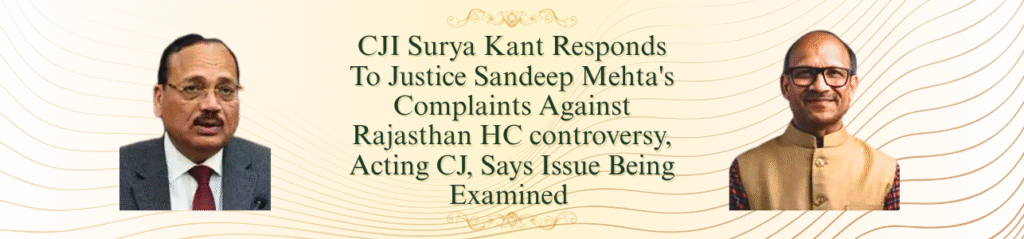
The Supreme Court of India once again found itself navigating the delicate terrain of judicial accountability and institutional integrity, as Chief Justice of India (CJI) Surya Kant formally addressed the continuing controversy surrounding complaints raised by Justice Sandeep Mehta against Rajasthan High Court’s Acting Chief Justice, Justice Sanjeev Prakash Sharma. The episode, which has drawn attention across legal circles, underscores the judiciary’s insistence on handling internal disputes through established mechanisms rather than public spectacle.
The Complaints
Justice Sandeep Mehta, a senior judge of the Rajasthan High Court, had earlier submitted multiple letters to the CJI alleging “gross maladministration” and “seriously questionable activities” by Acting CJ Sharma. These letters, dated August 2, 10, and 17, were not merely personal grievances but were said to be based on inputs from fellow judges and credible sources within the High Court. Justice Mehta pressed for Sharma’s replacement, citing concerns about the functioning of the court under his leadership.
CJI Surya Kant’s Position
On August 27, 2026, CJI Surya Kant reiterated his stance that such allegations cannot be adjudicated in the public domain. He emphasized:
- Institutional Mechanisms: Complaints against sitting judges must be examined through proper channels, not through media debates or public campaigns.
- Due Process: Both Justice Mehta’s submissions and Justice Sharma’s responses are being considered before any decision is taken.
- Collegium’s Role: The Collegium is actively working to appoint permanent Chief Justices in High Courts, reducing reliance on Acting CJs and ensuring stability.
The CJI’s remarks reinforced the principle that judicial independence requires disputes to be resolved internally, away from external pressures.
Why This Matters
The controversy is significant for several reasons:
- Judicial Accountability: Allegations of maladministration at the level of Acting CJ raise questions about governance within the judiciary.
- Public Confidence: The judiciary’s credibility depends on its ability to address internal issues without undermining public trust.
- Media’s Role: The CJI’s caution against media trials reflects a broader concern about how public discourse can distort judicial processes.
Rajasthan High Court in Focus
The Rajasthan High Court, like other High Courts, plays a crucial role in adjudicating matters of civil liberties, governance, and criminal justice. Allegations of questionable activities at its helm risk affecting morale and functioning. Justice Mehta’s letters suggest that these concerns are not isolated, but shared among multiple judges, heightening the urgency of resolution.
Retirement Timeline
Justice Sanjeev Prakash Sharma is scheduled to retire on September 26, 2026. This timeline sets a natural deadline for the Collegium to act. Whether a permanent Chief Justice is appointed before his retirement or the transition occurs afterward will be closely watched.
Collegium Dynamics
The Supreme Court Collegium, comprising the CJI and senior judges, is tasked with appointments and transfers. The current controversy adds pressure on the Collegium to expedite the appointment of a permanent CJ for Rajasthan HC. The episode also highlights the need for reforms to ensure timely appointments and reduce reliance on Acting CJs.
Broader Judicial Philosophy
CJI Surya Kant’s response reflects a philosophy that prioritizes:
- Integrity over expediency.
- Due Process over public spectacle.
- Balance between accountability and independence.
This approach is consistent with past Supreme Court positions, where internal mechanisms were preferred to safeguard judicial dignity.
Reactions from Legal Community
Legal experts have expressed varied views:
- Some support the CJI’s insistence on institutional processes, arguing it protects judicial independence.
- Others call for greater transparency, especially when allegations involve maladministration.
- A few commentators suggest reforms in the Collegium system to ensure smoother transitions.
Historical Parallels
The judiciary has faced similar episodes in the past, where complaints against judges surfaced but were resolved internally. The tension between transparency and confidentiality has been a recurring theme, particularly in judicial appointments.
Conclusion
The events of August 27, 2026, reaffirm the judiciary’s commitment to handling internal disputes through established mechanisms. As the matter is examined, the outcome will shape perceptions of judicial governance in India. With Justice Sharma’s retirement approaching, the Collegium’s decision on appointing a permanent CJ for Rajasthan HC will be pivotal. For now, the Supreme Court has made it clear: allegations against judges must be addressed institutionally, not through media trials.
Summary
The Supreme Court of India is examining complaints raised by Justice Sandeep Mehta against Rajasthan High Court Acting Chief Justice Sanjeev Prakash Sharma. Justice Mehta, in letters dated August 2, 10, and 17, alleged maladministration and questionable activities by Justice Sharma, citing inputs from fellow judges. Responding, CJI Surya Kant reiterated that allegations against sitting judges cannot be adjudicated in the public domain or through media trials, but must follow institutional mechanisms. He confirmed that both Justice Mehta’s materials and Justice Sharma’s responses are under review. The CJI also noted that the Collegium is working to appoint permanent Chief Justices in High Courts, reducing reliance on Acting CJs. Justice Sharma is due to retire on September 26, 2026, making resolution time‑sensitive. The episode underscores the judiciary’s emphasis on integrity, accountability, and due process in addressing internal disputes.