
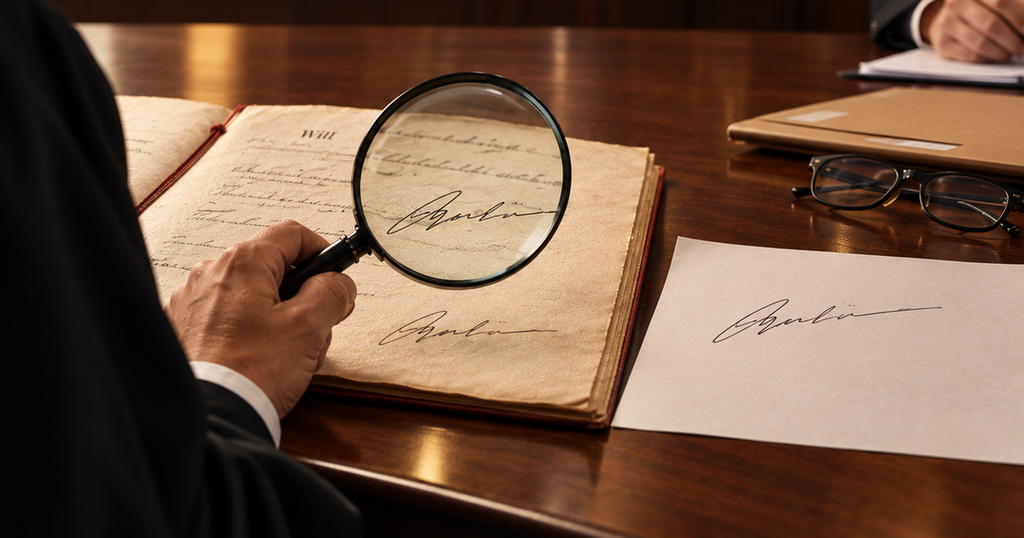
On 18 September 2026, Justice Ahsanuddin Amanullah and Justice Manmohan ruled on Gopal Pathak v. Nitin, alias Pappu and Another (Civil Appeal No. 13004 of 2026). The ruling resolves an eviction disagreement on a brief matter. It also clarifies how a court’s internal signature comparison under Section 72 of the Bharatiya Sakshya Adhiniyam, 2023 (BSA) aligns with expert testimony under Section 39.
The matter started as an eviction lawsuit before the 12th Civil Judge, Junior Division, Gwalior. The tenants, who are the respondents, claimed that the Testament was not authentic and requested its submission to a handwriting expert. On 6 October 2025, the trial court declined, stating it was competent to resolve the issue itself. On October 27, 2025, the High Court of Madhya Pradesh at Gwalior reversed that decision and stated that it was “essential” to send the Testament to an expert.
The appellant, Gopal Pathak, challenged this in the Supreme Court. He argued that the respondents had admitted a 1981 sale deed recording their father as a tenant, so they could not rely on it and also repudiate it. He also said the respondents asked for an expert four years after the trial began and after evidence was recorded, which would reopen the whole process. The respondents relied on Thiruvengada Pillai v. Navaneethammal (2008) 4 SCC 530, saying a court’s own finding on disputed handwriting can be risky.
The Question Before the Court
The Court framed it as a short point: is expert opinion under Section 39 BSA “essential” to decide whether the Will is genuine, or can the court decide by comparing the signatures under Section 72 BSA?
What is Section 72 of the BSA?
Section 72 deals with comparing a signature, writing, or seal with others that are admitted or proved. It lets the court itself check a disputed writing against a genuine specimen.
- Section 72(1): To decide whether a signature, writing, or seal belongs to the person it claims to be from, the court may compare it with one that is admitted or proved to the court’s satisfaction to be that person’s. The specimen need not have been proved for any other purpose.
- Section 72(2): The court may direct any person present in court to write words or figures, so it can compare them with the disputed ones.
- Section 72(3): The section applies, with necessary changes, to finger impressions.
Section 39 BSA makes expert opinions on matters such as handwriting a relevant fact. Under the Court’s reasoning, that opinion is an aid and is not binding on the court.
What the Court held
- Discretion: The court is permitted by law to either examine the signatures directly or request an expert assessment.
- Responsibility: It is the court’s responsibility to compare the writing. It cannot be evaded by claiming the court lacks expertise.
- Not conclusive: Expert testimony is merely an opinion and does not obligate the court. Therefore, the High Court’s perspective that an expert was necessary was legally unsustainable.
- When an expert may assist: The court has complete authority to request one when it has uncertainty or when the writing or impression is unclear, indistinct, or extremely faint.
- The previous case: Thiruvengada Pillai was concerned about a fingerprint. Paragraph 16 does not necessitate an expert in each case involving disputed handwriting, signatures, or fingerprints.
The Outcome
The Court allowed the appeal, set aside the High Court’s order and restored the trial court’s order of 6 October 2025. It noted that what the trial court finally holds about the Will can still be challenged by the aggrieved party. Because this is an eviction matter, it asked that the case be expedited.
Beyond this case, a few points are worth noting:
- Narrow point. The order rests on the short point above. It does not discuss the appellant’s other arguments, such as the sale deed or the delay in asking for an expert.
- Not a ban on experts. An expert can still be called when the court has doubt.
- Examples, not a checklist. Doubt and smudgy, vague or very light writing are given as examples of when a court may seek expert help, not as a fixed list.
- The merits are open. The order does not decide whether the Will is genuine.
So, must a court send a disputed Will to a handwriting expert? The Supreme Court says not as a matter of course. The court must compare the writing itself, and it may call an expert where it has doubt or the writing is hard to read. How that discretion works will become clearer in individual cases.
This post is commentary on a published judgment and is not legal advice.
Case Details
- Citation: 2026 INSC 1085 [VERIFY]
- Date of Judgment: September 18, 2026
- Case Number: Civil Appeal No. 13004/2026 (arising out of Special Leave Petition (C) No. 513/2026)
Court: Supreme Court
Bench
- Judges: Justice Ahsanuddin Amanullah and Justice Manmohan
Parties
- Appellant: Gopal Pathak
- Respondents: Nitin alias Pappu and Omprakash (the tenants)