
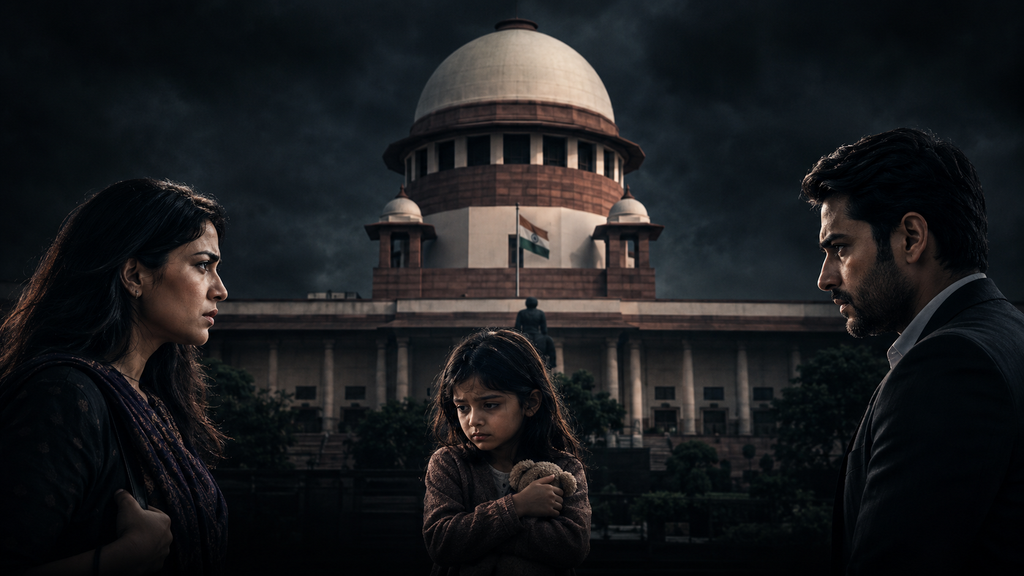
The Supreme Court has set safeguards for POCSO complaints made during custody disputes. Here is what it decided and what it left open.
On 24 September 2026, Justices J.B. Pardiwala and K.V. Viswanathan decided ‘R’ v. ‘E’ and Another (Civil Appeal No. 13119 of 2026). The judgement decides one family’s dispute and also sets general safeguards for POCSO complaints made against a parent during a matrimonial dispute. The Court called the misuse of such allegations a growing menace but stressed that the safeguards must not dilute the POCSO Act.
The parents married in 2011 and had a child in 2015. The mother left the home with the child in 2018. The father then sought guardianship and won custody in the Family Court, the High Court, and the Supreme Court. In March 2024, while his appeal on visitation was pending, the mother lodged a POCSO FIR against him and his family.
The Supreme Court transferred the investigation to the CBI, which worked with NIMHANS child psychiatry and clinical psychology experts. The CBI found no signs of trauma consistent with the allegations. It said prolonged parental conflict, ongoing custody litigation and repeated discussion of the allegations may have influenced the child’s account. It concluded that the testimony was unreliable and the allegations not made out. The Court agreed, quashed the FIR as an abuse of process, and found it had been registered to lay a foundation for returning custody to the mother.
The safeguards
They apply only when a POCSO offence is alleged against a parent or a family member living with the child, and the parents are in a matrimonial dispute, whether or not it is in court.
In those cases:
- Before arrest: The investigating officer must engage a child psychiatrist or clinical psychologist, through the District Child Protection Unit, to assess the child independently. The expert can be skipped only where the material is clear, and written reasons must be recorded.
- Not binding: The expert report helps the officer decide. It does not bind the officer and cannot alone justify a chargesheet or closure.
- Private complaints: The Special Court should involve an expert before issuing summons.
- Courts: Remand and bail courts should check whether the arrest decision considered the circumstances of the complaint. Custody courts should not treat registration of a POCSO case as proof of the allegation.
These safeguards apply to investigations still pending and to private complaints where summons have not yet been issued.
The outcome
The Court quashed the POCSO FIR and an earlier 2018 FIR, ended the mother’s fresh guardianship petition, and closed the contempt petition. Applying the child’s welfare principle, it gave legal custody to the father. The Family Court will supervise the child’s reintegration with the father, advised by an expert committee.
Beyond this case, a few points are worth noting:
- Narrow scope. Complaints against relatives outside the household, or where no parental dispute exists, fall outside the safeguards.
- An aid, not a decision. The officer may disagree with the expert report, and it cannot alone justify closing a case. The investigation continues.
- Practical questions. The judgement sets no firm deadline for the evaluation, and it depends on experts being available in every district.
- Unusual facts. The expert input here came from a CBI-led committee in a Supreme Court-supervised case. District agencies will need a much lighter version of that process.
So, can a POCSO complaint be a custody weapon? The Supreme Court says it can be misused, but it does not say such complaints are usually false. What it asks for is care: an expert voice for the child before an arrest and courts that look at why and when a complaint was made. How well that works will depend on what happens on the ground, in police stations and in district offices.
This post is commentary on a published judgement and is not legal advice.
Case Details
- Citation: 2026 INSC 1049
- Date of Judgement: September 24, 2026
- Case Number: Civil Appeal No. 13119 of 2026 (arising out of Special Leave Petition (C) No. 1092 of 2024)
Court: Supreme Court
Bench
- Judges: Justice J.B. Pardiwala and Justice K.V. Viswanathan
Parties
- Appellant (‘R’): The Husband (Rajeev Giri)
- Respondent (‘E’ and Another): The Wife (Ekta Singh) and Another
Connect with us on: